
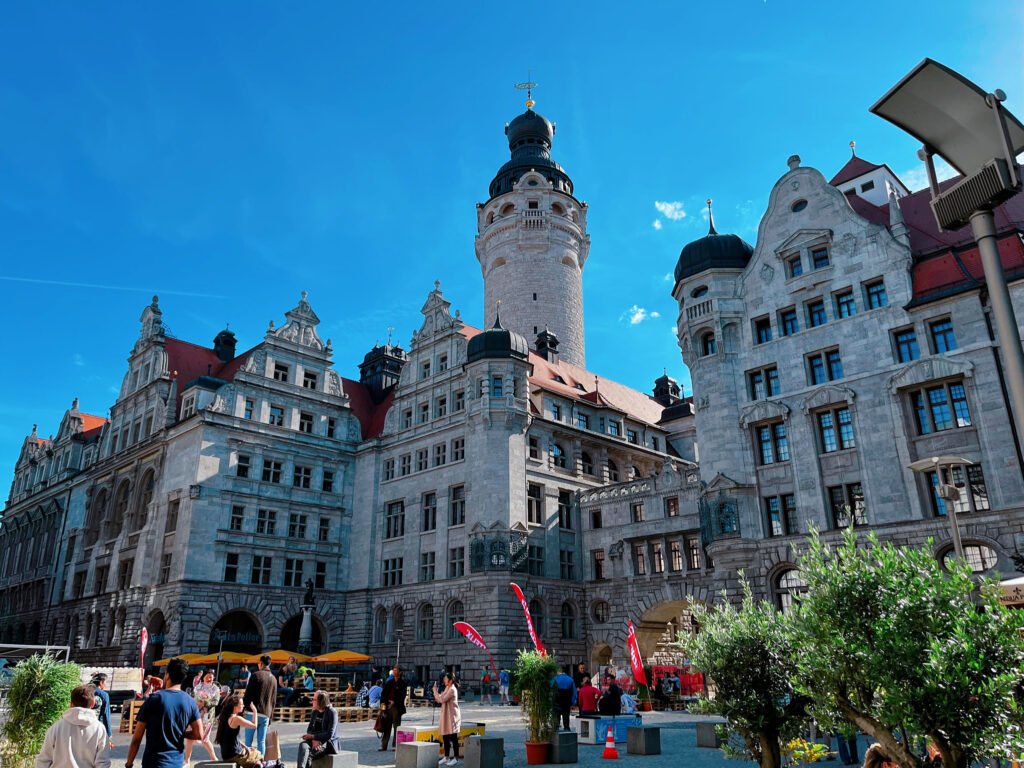
Just an hour and a half by train from Berlin, Leipzig is a historic city that you can easily visit on a day trip.
I’ve only been there once, but the city left a deep impression on me — small in scale yet rich in history, with a calm and dignified atmosphere. Once a thriving hub of trade, education, and printing, Leipzig was long regarded as a “city of intellect and the arts.” As you stroll through its old streets, you can feel the presence of music and literature everywhere — a refined quietness quite different from Berlin. Interestingly, the young Goethe once studied at Leipzig University, and his experiences there are said to have inspired parts of Faust.

🚉 Leipzig Central Station — A Grand Gateway to the City
Stepping off the train at Leipzig Central Station — one of the largest in Europe — you’re greeted by a striking contrast: a stately stone exterior and a bright, spacious interior filled with natural light. My family and I couldn’t help but exclaim, “Wow, it’s huge!” 😄
Although it was destroyed during the war, the station was later rebuilt, blending traces of the past with a fresh sense of modern energy. Inside, you can even see some of the old trains on display — a great photo spot! The shopping mall inside the station is beautiful, with a wide variety of stores. What surprised me most, though, was the Starbucks Café— with its high ceilings and classical interior, it felt more like a historic salon than a modern café. What a luxurious place to enjoy coffee! 😄
After admiring the station, we made our way toward the Old Town.

🎼 The City of Bach
Every corner of Leipzig seems to echo with the footsteps of Johann Sebastian Bach, who spent the last 27 years of his life here. Born in Eisenach in 1685, Bach devoted his entire life to music, serving as an organist, court musician, and composer in various German cities. His years in Köthen produced masterpieces like the Brandenburg Concertos, while his move to Leipzig in 1723 marked the beginning of a particularly fruitful period.
Here, he served as Cantor of St. Thomas Church (Thomaskirche) — composing new church music each week and training choirs and orchestras.
⛪ St. Thomas Church — Where Bach Rests
Inside the church, your eyes are immediately drawn to the beautiful rib-vaulted ceiling and colorful stained-glass windows. Near the altar lies Bach’s tomb, always surrounded by fresh flowers. When we visited, we happened to arrive during an organ rehearsal — the solemn sound filling the church was absolutely moving.

St. Thomas Church also played an important role during the Reformation. In 1539, Martin Luther preached here, and as I stood before the pulpit, I couldn’t help but imagine him speaking to the congregation centuries ago. It reminded me of my visit to Wittenberg — history truly connects across time. (You can read my blog about Wittenberg here 👉 A Day Trip to Wittenberg  Birthplace of the Reformation)

🎶 Bach Museum — A Musical Life Shared with Family
Next, we visited the Bach Museum Leipzig, located on the site where Bach’s home and the old St. Thomas School once stood. Here, Bach lived with his family while fulfilling his duties as music director.
The museum displays instruments from his time, manuscript copies, and family portraits, vividly showing how deeply his life was intertwined with faith and music. I was especially fascinated by a family tree handwritten by Bach himself — meticulously detailed, revealing his curiosity and discipline. You can also listen to his music throughout the museum, which makes the experience even richer. We spent so much time there that we lost track of it! 😅

🏰 A View from the Church Tower
Since my family loves climbing towers, we couldn’t resist going up the one next to the church. The entrance was small, almost hidden, and we noticed it only because people were lining up. Inside, a narrow wooden staircase creaked with each step, and passing others was a challenge. Still, with a guide leading the way, it felt safe.
Along the way, you can see the intricate wooden beams supporting the roof — like a maze of craftsmanship from another era. At the top, a peaceful panorama of red rooftops and quiet streets unfolds below.

☕ A Taste of Leipzig at Kümmel Apotheke
After walking for hours, we stopped at Kümmel Apotheke, a cozy café inside the elegant Mädler-Passage. Once an old pharmacy, it now combines wooden warmth with a classical interior.
I ordered a local specialty, Gose beer, known for its gentle herbal and coriander aroma — perfect for someone like me who loves herbal flavors. I also tried the city’s traditional pastry, Leipziger Lerche. In the 19th century, eating real larks (the birds called Lerche) was banned, and this sweet was created as a symbolic replacement.
It’s a delightful little tart filled with marzipan and jam, and you can find it in bakeries and even train stations. The one I had came with vanilla sauce and whipped cream — beautifully presented and absolutely delicious! It’s a dessert I’d love to recreate someday.

🎹 Final Thoughts
This time, we focused so much on Bach that we couldn’t visit the sites connected to Mendelssohn, Schumann and Wagner, or even Japan’s own Rentarō Taki, who once studied here — something I’d love to do next time.

Through Bach, I came to understand how faith, family, and culture were all woven into Leipzig’s identity. When I was a child learning piano, I used to struggle with Bach’s pieces 😅 — but after this visit, understanding the background and spirit behind his music, I suddenly felt like playing them again.
Leipzig may be a small city, but it’s filled with quiet inspiration and the living soul of music.
For anyone who loves classical music, it’s a place you simply must visit.